Jun 3, 2026 · 4 min read
Knife Skills Without the Fear
Good knife skills are not about speed. A sharp blade, a steady board, the pinch grip, and a curled guiding hand will make chopping calmer and safer, and one onion is all you need to start practicing tonight.
Words by Marisol Ortega
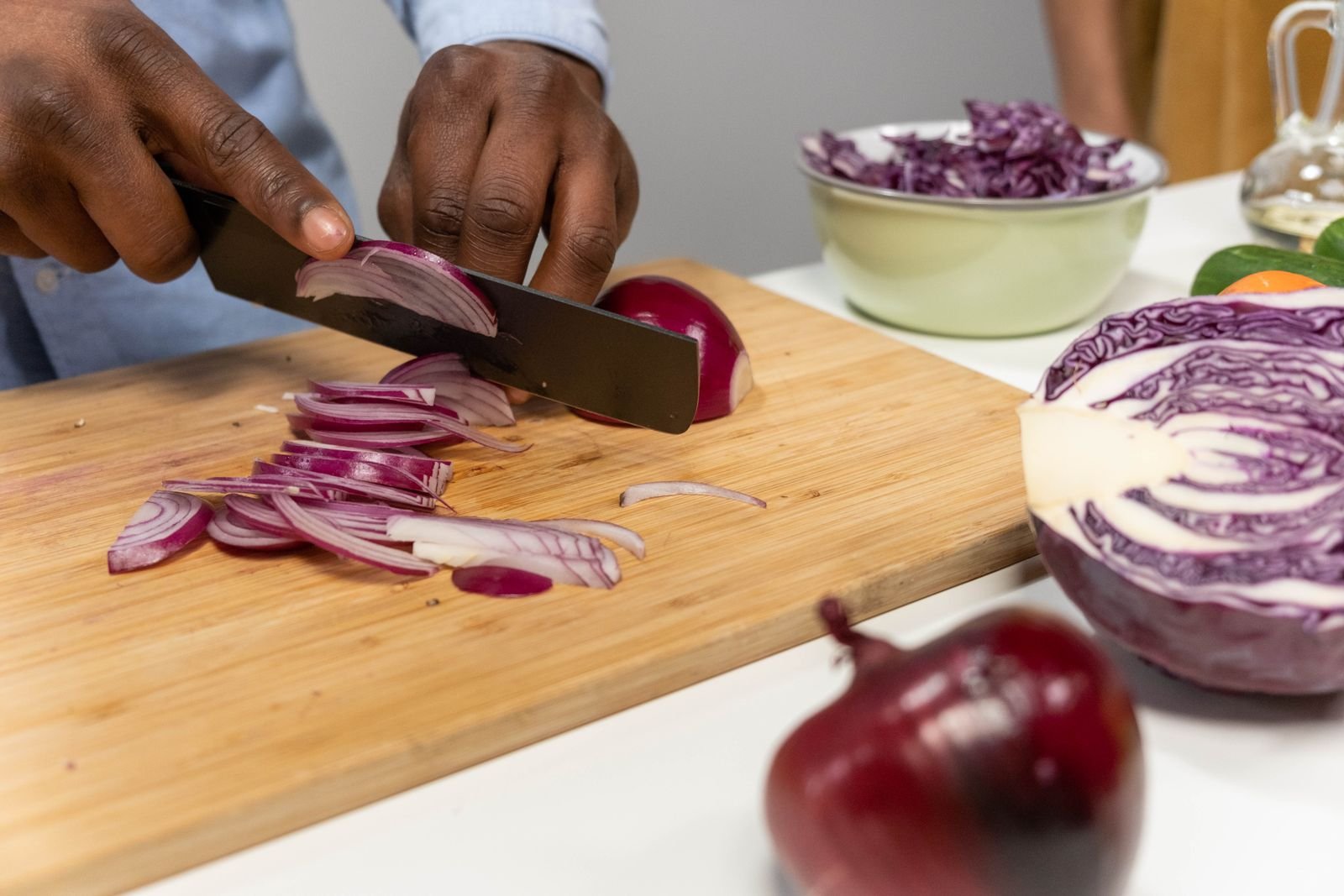
A lot of people chop vegetables the way they would handle a wasp: carefully, slowly, and from as far away as possible. That wariness is understandable, but it is also what makes cutting feel awkward and, ironically, more dangerous. Good knife skills are not about speed. They come from a few simple habits that keep your fingers safe and your cuts even.
A sharp knife is a safer knife
Dull blades slip. They skid off onion skins and tomato peels and need extra force to push through, and force is what sends a knife somewhere you did not intend. A sharp knife bites into the food right where you put it. Hone your knife with a steel every few uses to straighten the edge, and sharpen it on a whetstone, or have it sharpened professionally, once or twice a year.
Set up a stable station
- Lay a damp paper towel or thin kitchen towel under your cutting board so it cannot slide.
- Use a board large enough to hold what you are cutting with room to spare. Crowding leads to rushing.
- Stand square to the counter with the board close to your body, so you are not reaching.
- Keep one bowl nearby for scraps and another for finished pieces.
Hold the knife like you mean it
Most beginners hold the handle like a hammer, sometimes with an index finger stretched along the spine. It feels secure but offers little control. Try the pinch grip instead: pinch the blade just in front of the handle between your thumb and the side of your bent index finger, then wrap your remaining fingers around the handle. It may feel odd for a day or two, but it lets you steer the tip precisely.
Make a claw with your guiding hand
Your other hand does just as much work. Curl your fingertips under slightly, like a loose claw, and rest them on top of the food with your knuckles facing the blade. The flat side of the knife rides against those knuckles as a guide, while your fingertips stay tucked behind, out of the path of the edge. To make the next cut, slide the claw back rather than lifting the knife high.
Create a flat side first
Round food rolls, and rolling food is where many slips happen. Before anything else, slice a thin piece off one side of a carrot or potato, or cut an onion in half, and set it cut side down. Now it stays put.
Two motions to learn
The rocking cut
Keep the tip of the knife on the board and rock the heel up and down as you move through the food. This suits a curved chef's knife and works well for herbs, garlic, and anything you want to mince finely.
The push cut
Lift the whole blade, then push it forward and down through the food in one smooth stroke, letting the knife glide rather than chopping straight down. This gives clean slices through firm vegetables.
Practice on an onion
Dicing an onion uses most of these skills at once:
- Cut off the stem end but leave the root end intact; it holds the layers together.
- Halve the onion through the root and peel away the papery skin.
- Lay one half cut side down. Make vertical cuts from near the root toward the stem end, stopping short of the root.
- Turn the knife flat and make one or two horizontal cuts toward the root, with your guiding hand flat on top.
- Slice across the vertical cuts using your claw, and the onion falls into dice. Discard the root.
The first few times, go as slowly as you need. Speed shows up on its own after a few dozen onions.
Habits that prevent accidents
- Never try to catch a falling knife. Step back and let it drop.
- Keep knives out of a sink full of soapy water, where someone could reach in blindly.
- Scrape with the spine. Flip the knife over to push chopped food across the board, which protects both the edge and your hand.
- Set the knife down to pass it, or hand it over handle first with the blade pointed toward the floor.
- Stay focused. If someone starts talking to you, pause cutting while you answer.
If you do nick yourself
It happens to every cook eventually. Put the knife down, rinse the cut under cool water, and press a clean towel firmly against it until the bleeding slows. For small cuts, a bandage and a disposable glove will get you back to work. Anything deep, gaping, or that will not stop bleeding needs medical attention.
A week of ten-minute practice
Pick one task a day. Monday, slice carrots into coins. Tuesday, dice an onion. Wednesday, mince garlic. Thursday, cut bell peppers into strips. Friday, stack basil leaves, roll them, and slice them into thin ribbons. By the weekend your hands will move with more confidence, and dinner prep will feel less like a chore.
Slow and steady is not a beginner's compromise. It is how good cooks work, too.